
In honor of America’s 250th Anniversary Celebration in 2026, Hoofprints of the Past Museum will be erecting a Wyoming State Historical marker overlooking this famous site located in the town of Kaycee. Once the sign is installed, the museum will hold a dedication event, where the history of the site is discussed as well as its connection to themes of the American Revolution in 1776. A date for this event will be announced soon.
The KC Cabin Gunfight site is where, in 1892, a vigilante group of the Wyoming Stockgrowers Association, surrounded a cabin where local rancher, Nathan D. Champion was staying. They were intent on killing him and the events of that day have been emulated in countless western movies. Alone, Champion managed to stand off the group, bent on his murder, the entire day. The vigilantes, known as the In
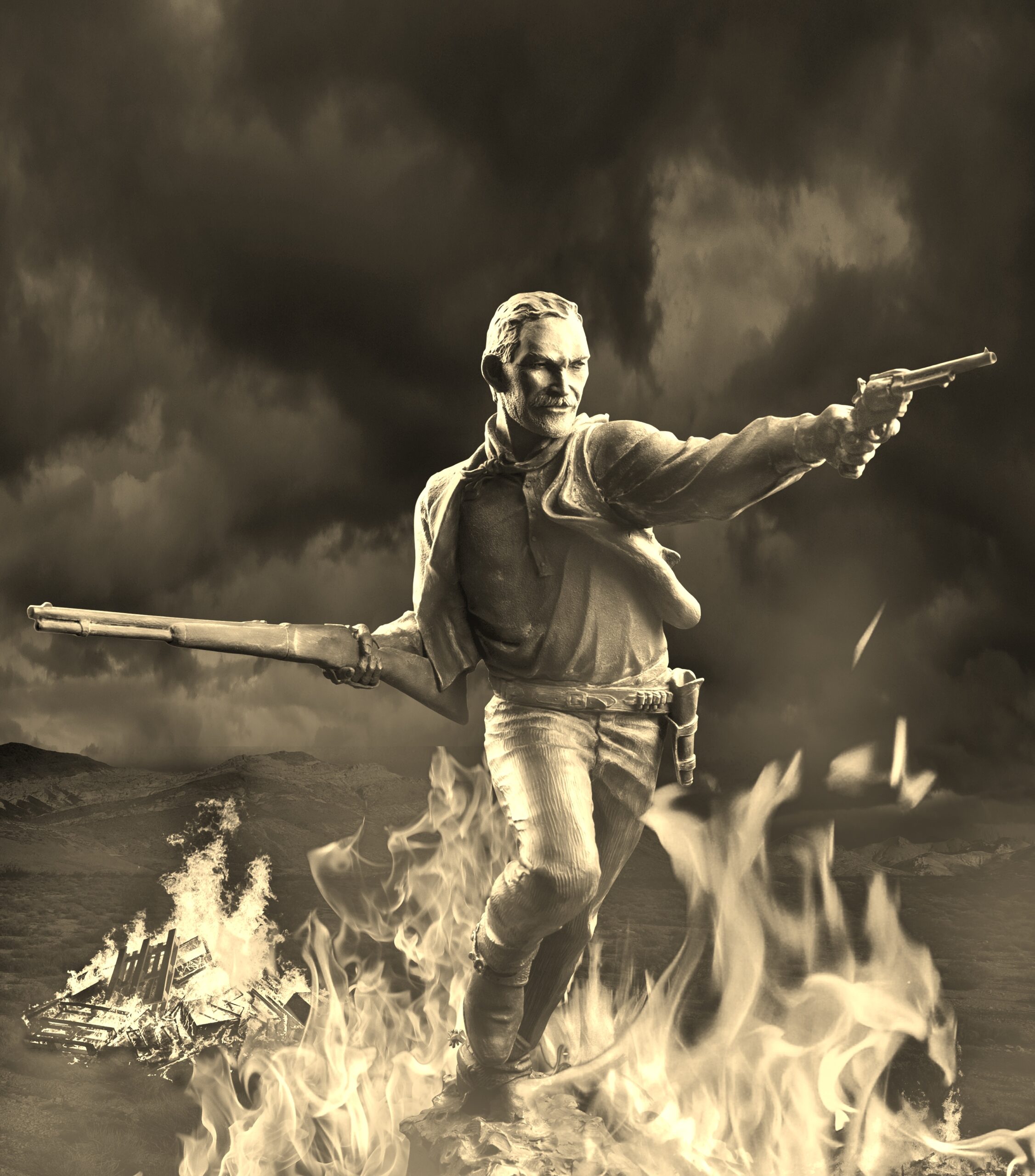
Photo based on “Champion’s Last Run” sculpture by artist D. Michael Thomas.
vaders, has a list of men they wanted to kill in Johnson County, including the county sheriff and commissioners. Their zeal for killing Champion, and his ability to delay their overall plans, likely saved many lives, and resulted in word of the attack getting out and a resistance organized.
The full background and history of this event is as follows:
By the late 1880’s, for a variety of reasons, much of the former booming cattle industry was in the process of busting. The cattle barons faced increasing competition as former cowboys and increasing numbers of settlers to the region began building their own herds. Such small cattlemen began legally homesteading the choicest spots on the public range that the cattle barons were accustomed to having to themselves.
Increased settlement, as well as the Homestead Act, combined to create overstocking of the range. Under the Homestead Act of 1862, settlers were allowed to acquire 160 acres of the range, which worked very well in establishing small farms east of the Mississippi. Unfortunately, in the arid West, farming was not feasible in most areas. However, it was ideal for grazing livestock, and so cattle ranching, imported by the Spanish to the new world came to the American West. Because ranching required more acres to make a living than the 160 acres allowed by the Homestead Act, ranchers would usually homestead on water and graze their cattle on the adjacent public range. Unfortunately, because no one owned it, everyone else grazed it too.
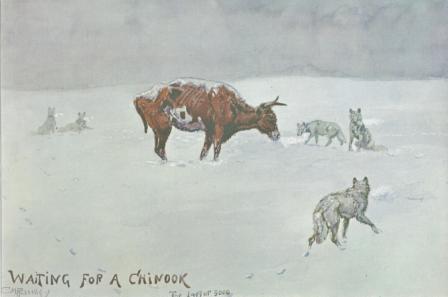
“Waiting for a Chinook” by Charles Russell captures the tragedy of the 1886 Blizzard
This overstocking would eventually culminate in the disastrous winter of 1886-1887. That winter, the thermometer dropped and the snow piled deep, where it remained all winter. Great blizzards swept the plains, and thousands upon thousands of cattle died from the exposure and the lack of grass.
Tensions between homesteaders, small-time cattlemen, cowboys, and the large cattlemen over the use of the range grew. The two groups also conflicted over the common practice of mavericking. Unbranded calves were considered “mavericks,” legally belonging to no one and could therefore be branded/thereby acquired, by anyone with a registered brand. Although mavericking was practiced by the large outfits, they started to view it as rustling when practiced by the smaller ranchers.
Soon the Cattle Barons began using their power and influence in the Wyoming Stockgrowers Association, the state government, and the press to maintain their control of the range. The Barons began to blackball cowboys who owned cattle; they enacted roundup laws favoring the large outfits and passed a law against mavericking. The big outfits also complained that it was cattle rustling, not their management, that was causing losses. By the late 1880’s and 1890’s, the press responded with sensational stories of lawlessness and cattle rustling in Johnson County.

Running Iron which could be carried horseback and used to brand maverick calves
The small cattlemen rebelled by conducting their own roundups and continuing to maverick. Local juries would not convict some accused rustlers, who were often framed by the big cattlemen and their stock detectives.
Resentments grew on both sides. With their control of the range slipping away, the Wyoming Stockgrowers Association used their stock detectives to intimidate homesteaders, and when that didn’t work, murder them under pretense of “rustling.” The newspapers cleared up any questions about the murders with outlandish accusations, such as in the lynching case of Ella Watson, vilified as a prostitute and rustler “Cattle Kate,” in 1891.
The assassination squad’s next target was Hole in the Wall rancher Nathan D. Champion. Like many of the local cowboys, Champion was from Texas. He worked as a cowboy for a time and was well-known as a top cow hand at the EK Ranch, as well as being good with a gun. He eventually acquired 200 head of his own cattle and came into conflict with the large outfits by defying the WSGA’s Round-up laws and riding directly into round-ups and cutting out his own cattle. He was considered a natural leader of the so-called rustler element, so much so that he was elected President of a new stock association formed by the small ranchers to oppose the WSGA even though Champion didn’t even attend that meeting. In addition, he was designated to lead this group’s announced spring roundup in opposition to the big outfits.

Hat Ranch Remuda
Champion also associated with many other hated small-timers. One of these associations was the Hat Ranch, believed to be the center of the so-called “rustler element in Johnson County.
The Hat Ranch was originally located on Red Fork, and its four partners included Jack Flagg, Martin Allen Tisdale (known as Al Allison due to his questionable criminal background), Billy Hill, L.A. Webb, and Tom Gardner. All had been blackballed from employment from the big outfits for their blatant disregard of the discriminatory round-ups laws implemented by the big cattlemen. Jack Flagg wrote against the actions of the large cattlemen in the local newspaper, earning particular hatred by the cattlemen.
The WYSG assassination squad, made of up Frank Canton, Fred Coates, Billy Liken, and Joe Elliot decided to kill Nathan D. Champion at the Hall Cabin, where he was staying in the Hole in the Wall in October 1891. The group of armed gunmen approached the cabin, and several men entered with pointed guns. In the dim light of the cabin however, they missed Champion, who was laying in the bed, allowing him time to grab his revolver and shoot back, wounding one and sending the others out the door. He pursued them out the door, and spotted Joe Elliot over the low cabin roof. The attackers fled.
Champion went to his neighbor and friend, John A. Tisdale, for help tracking down the men who attacked him. Tisdale’s Red Fork neighbor, Orley “Ranger Jones” accompanied them, and the group encountered Mike Shonsey, foreman for the Bar C and spy for the big cattlemen. Shonsey held the horses at the attack on the Hall Cabin, and Champion forced him to spill the names of the others there. This made both Tisdale and Jones witnesses, per the legal rules at the time, in the upcoming trial for the attempted murder of Champion by Joe Elliot. Any conviction of a member of the assassination squad, such as Elliot, would likely lead directly back to their powerful employers- the Wyoming Stockgrowers Association.
This required more drastic action by the big cattlemen.
On November 20, 1891, Ranger headed North to Buffalo in a wagon to buy flooring lumber for the cabin. He told his brother he would be back in 4 or 5 days. On his way back home, about fourteen miles from Buffalo at the Muddy Creek Bridge, men with guns emerged and shot Ranger in the back. The horses stampeded, but the killers caught up to the wagon, freed the horses, and concealed the wagon and body out of sight from the road. His body was found days later, when his brother came looking for him.
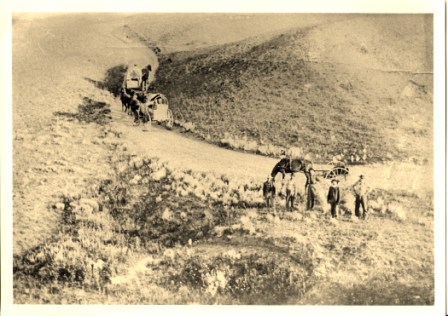
Tisdale Gulch where rancher John A. Tisdale was murdered
Prior to the discovery of Ranger’s body, another murder had been found, that of John A. Tisdale. From Texas, Tisdale attended college and then became an able cowboy, bossing several cattle drives to the North, and even working for Theodore Roosevelt as foreman until he came to Johnson County to start his own ranch. He homesteaded on Red Fork and built a small herd of cattle and horses. Tisdale reportedly felt he was in danger when he left Buffalo in late November after a trip to town for supplies and Christmas presents for his family. It was in a gulch south of the Cross H Ranch where Tisdale was shot from behind by a hidden killer.
The murderer was most certainly Frank Canton. Canton was actually Joe Horner, a man with a criminal past, who escaped to Wyoming on a cattle drive and changed his name. As Frank Canton in Wyoming, Canton worked as a cowboy, ingratiating himself with various ranch owners and the Wyoming Stock Growers Association, which resulted in his employment as a stock detective. He was elected Sheriff of Johnson County in 1882 and served two terms. He remained as stock detective for the WSGA, but became frustrated by the seeming inability to convict a rustler. The political winds had shifted, and the tide of the majority of the local population was against the large cattlemen by then. Canton declined to run for a third term and was replaced by pro-small rancher Sheriff Red Angus.
Despite an increasingly armed and rebellious mood among Johnson County citizens, the cattle barons resolved to attempt to squelch their opposition with an armed invasion designed to kill the so-called “rustler element” ringleaders, such as Red Angus. In April 1892, the Barons organized and some led a group of about 50 armed men, made up of their employees, Wyoming Stockgrowers Association range detectives, and Texas hired guns. They became infamously known as the “Invaders”.
The Barons took a secret train to Casper. From there, they rode to John N. Tisdale’s TTT Ranch, which was in league with the Invaders, and rested for the night. There they learned from Mike Shonsey that several rustlers were holed up at the Nolen cabin of the KC Ranch, including supposed ringleader Nate Champion. Consequently, rather than proceeding with haste to Buffalo, and against Canton’s advice, they decided to stop at the KC Ranch.

KC Ranch Barn
On the morning of April 9th, 1892, the Invaders positioned themselves undetected around the Nolen cabin in Kaycee, where the “rustlers” were staying. Two trappers, who were also staying at the cabin were captured by the Invaders when they went to get water.
When the two trappers failed to return, Nate and his friend, Nick Ray, became suspicious. Nick cautiously stepped out but was mortally wounded. Under heavy fire, Nate dragged him back into the cabin. Nick soon died as Champion continued to hold off his attackers. The bullets came in like hail, with occasional pauses in the firing.
It was during one of these pauses that Jack Flagg (also high on the Invader’s list of people to kill) and his seventeen-year-old stepson, Alonzo Taylor came by. As they neared the bridge, several men ordered him to halt and fell in behind him. Jack recognized Mike Shonsey’s horse, which tipped him off that there would be trouble, so he kept going. The men started firing, stampeding the team across the bridge. Jack also made it across the bridge, dodging bullets along the way, but the Invaders were afraid to follow because Nate Champion had a clear shot the length of the bridge. Jack caught up with Alonzo, Alonzo cut a horse from the team, Jack grabbed a rifle (which only had three shells in it) and took off. With bullets dropping around them, they managed to escape.
Unfortunately, Jack and Alonzo had left the means for the invaders to get Nate Champion. The Invaders took the wagon they had abandoned, filled it with hay and wood, and pushed it up against the cabin, where it was set ablaze. With the cabin billowing smoke, Nate emerged from the back at a run, with his rifle and revolver, attempting to escape into a nearby ravine. There was no escape, and two invaders shot him.
However, the Invaders zeal for killing Nate, who fearlessly held the Invaders off for hours, delayed them long enough for word to get out about the events unfolding. This allowed time for an alerted citizenry to rise up in fury against the Invaders.
After killing Nate, the Invaders made their way North to continue their attack. However, word reached the Invaders that a large hostile opposition group was heading towards them. They holed up at the
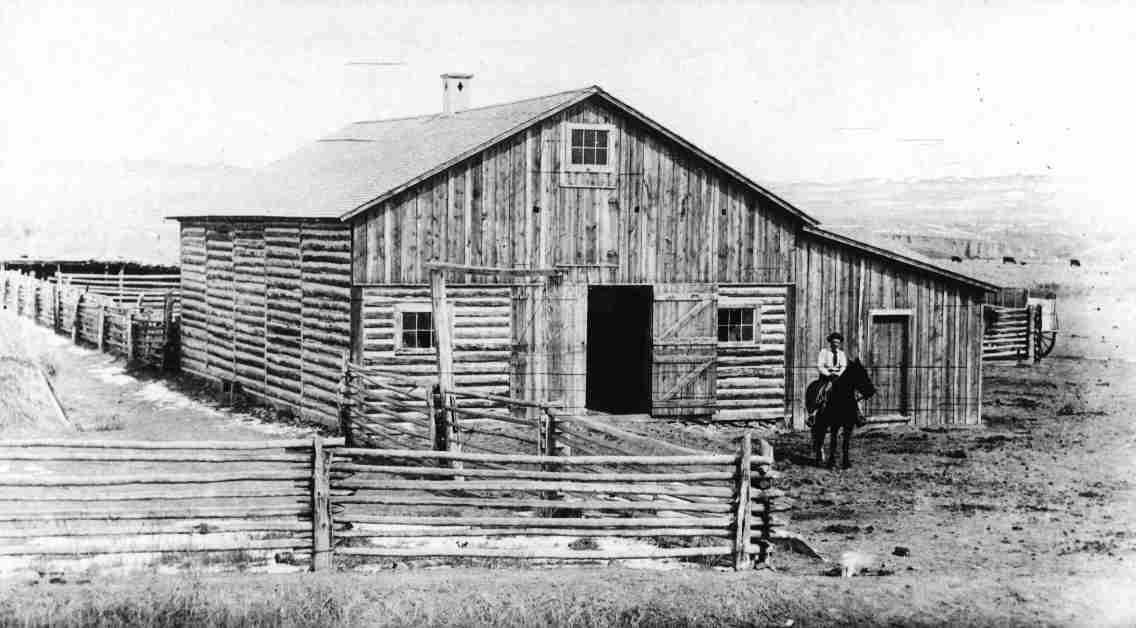
TA Ranch Barn
pro-Invader TA Ranch where they were besieged by local law enforcement and citizenry in a three-day gun siege. In all likelihood they would have been killed, the buildings that sheltered them burned over their heads or shot when they attempted to escape, except for the intervention of their powerful friends in Cheyenne and Washington, including the Governor, Senators, and even the President of the United States. The military was dispatched from Ft. McKinney just in time to take the besieged men into custody, thereby saving their lives. They were put under house arrest in Cheyenne, given their guns, and told not to leave town. The Texans all went home, and none of the Invaders were ever charged for their crimes. Locals have not trusted Cheyenne, or Washington D.C., ever since.
More Resources:
Wyoming Range War by John W. Davis
Johnson County War by Bill O’Neal
War on Powder River by Helena Huntington Smith
Banditti of the Plains by Asa Mercer
Johnson County War Historical Tour: Johnson County War Tour – Hoofprints of the Past Museum